

In each episode we share the stories of farmers who are discovering ways to farm with nature, and explore how we can all help more farmers to head in this direction, for healthier food, humans and planet. These stories show how resilient, regenerated soils and landscapes can support profitable food-producing businesses, thriving and resilient people and regional communities, and abundant and nutritious food.
Listen to the episodes below, or head over to your preferred platform.
Subscribe to our newsletter or socials to hear of the latest episodes



Featured episodes
Regenerative grazing and the key insights of Holistic Management, with Brian Wehlburg
We talk about his perspective on regenerative grazing, about the key insights of Holistic Management, the deeply held paradigms that often prevent people from seeing these insights, the practical steps that he has seen work to help people get started, the positive life changes that can result when people succeed and more.
All Episodes
Grazing profitably in the harsh beauty of the Central Queensland downs, with Ben Simpson
Ben Simpson runs Thistlebank, a 22,800 hectare cattle property near Aramac in Central Queensland that has been in his family for five generations. He came to the property from a very different life as a fitter and turner on the Gold Coast and has run it since 2010, joined by his wife Kim in 2014.
A hard drought in the late 2010s meant more money was going out the door than coming in, so Ben went looking for a different approach. In 2022 he did the KLR Marketing and RCS Grazing for Profit courses, followed by RCS’s Next Steps coaching and Executive Link programs. Since then, Ben and Kim have moved from set stocking to cell and rotational grazing. Their minimum ground cover has gone from around 40% to 60% or more, and their benchmark carrying capacity has risen from around 6 to 15–20 stock days per hectare per 100 mm of rain. They now rank in the top 20% of RCS’s profitability benchmarks. Ben has also started working with RCS as a coach and adviser.
In this episode, we talk about:
- How Ben went from the Gold Coast to running Thistlebank, and what made him stay
- Why financial pressure during drought led him to seek out training, starting with marketing and business skills
- Starting small and scaling up, from 16 or 17 mobs down to four mobs of 700 to 1,200 head
- Running intensive cell grazing on 6,000 hectares and a slower rotation across the rest of the property, working with flooding, access and labour constraints
- Planning grazing 12 to 18 months ahead with feed budgets, so that small adjustments made early avoid forced sales later
- Shifting from breeders to trading cattle to match stocking rate to carrying capacity, and to suit the people running the place day to day
- How goats fit into the system, and the paradigm shift of seeing grass grow back under timber
- Why coaching, peer support and a written vision have been central to the change
Ben features as a case study farmer in our Practice Guide: Grazing for Soil and Landscape Regeneration. He was due to host a field day at Thistlebank with Soils for Life and RCS, but recent flooding has put that on hold. Instead, we’ll be running a webinar with Ben and RCS Managing Director Dave McLean. Details on our website.
More
Links and resources
- Soils for Life Practice Guide: Grazing for Soil and Landscape Regeneration: https://soilsforlife.org.au/practice-guide-grazing-soil-landscape-regeneration/
- Webinar with Ben Simpson and Dave McLean: https://events.humanitix.com/grazing-for-soil-and-landscape-health-field-day-thistlebank
- RCS: https://www.rcsaustralia.com.au/
- RCS Grazing for Profit: https://www.rcsaustralia.com.au/farming-grazing-for-profit-programs/
- RCS tools, including FarmEye: https://www.rcsaustralia.com.au/tools/
- KLR Marketing: https://klrmarketing.com.au/
- The Long Paddock (Queensland Government ground cover and climate data): https://www.longpaddock.qld.gov.au/
- CarbonLink: https://www.carbonlink.com.au/
More from our grazing series
- From feeding animals to feeding biology, with David and Ruth Read: https://open.spotify.com/episode/21dVEksiDbbDDQTWLrZxGT
- Regenerative grazing and the key insights of Holistic Management, with Brian Wehlburg: https://open.spotify.com/episode/7bWGHbRB332rYcw9bLwt90
This episode was hosted by Eli Court, produced by Jen Sheridan and edited by Chris Wieffering.
We’d love to hear your feedback, questions or ideas for future guests. Get in touch on social media or at [email protected].
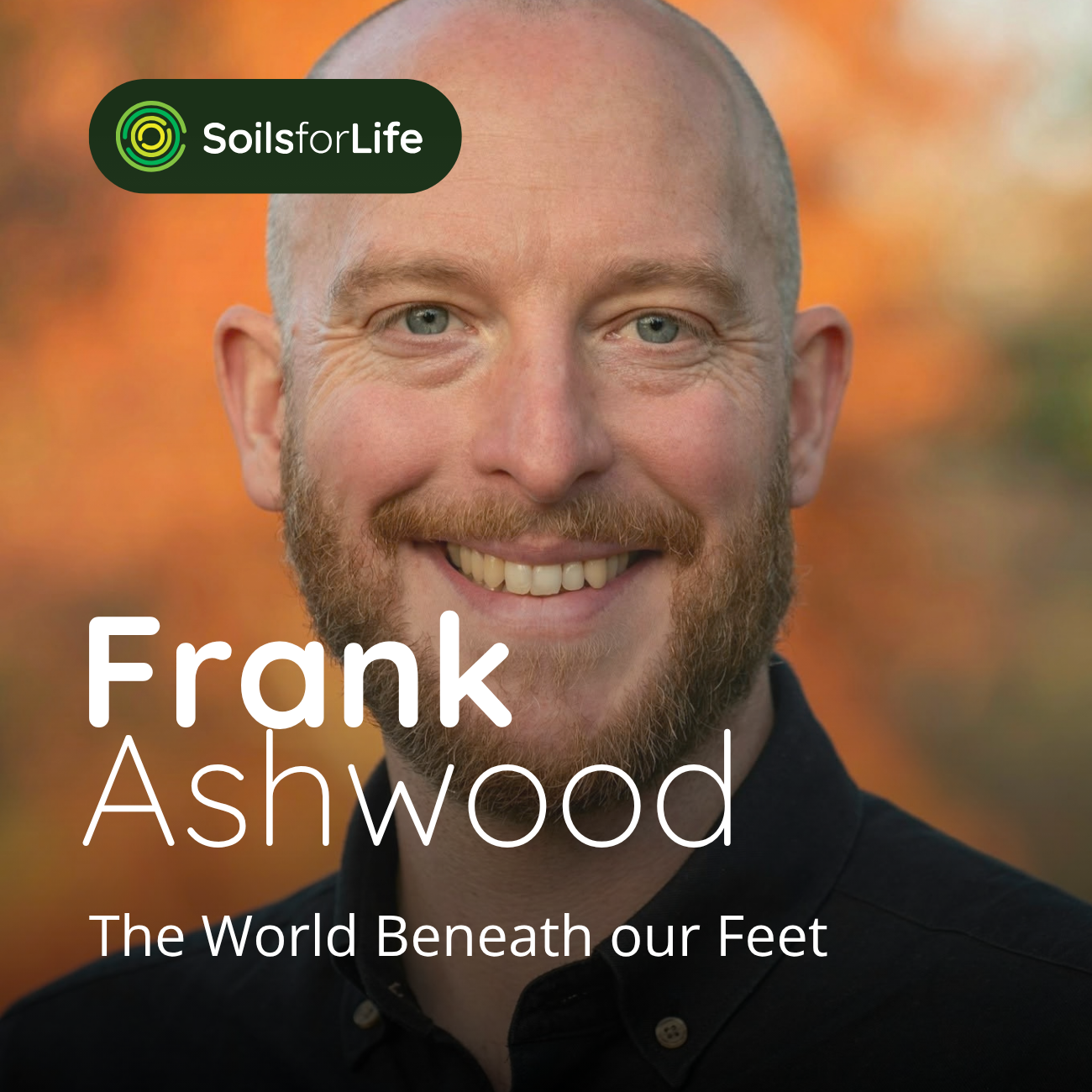
The World Beneath our Feet, with macrophotographer and soil ecologist Frank Ashwood
Frank Ashwood is a soil scientist with a side passion for macrophotography – photographing the incredible creatures and organisms living in the soil. He has an academic background in biology and land restoration to woodland. He mostly studies the biological diversity and associated functions of forest soils, but three years ago Soils for Life brought Frank Ashwood to Australia to turn his camera to the life in the soil on farms across six regions. The photographs were astounding, and a number of them have now been included in his new book: The World Beneath our Feet: The Hidden Life of Soil and Why It Matters to Us All.
In this episode, we discuss some of the incredible creatures that live in the soil, diving into how each layer of soil differs, and some of the experiences and observations on farms around Australia.
More
Links and resources
- The World Beneath our Feet: The Hidden Life of Soil and Why It Matters to Us All, by Frank Ashwood https://www.frankashwood.com/twbof
- Frank Ashwood book launch at Fat Pig Farm on 10 October: https://zfszi4-wi.myshopify.com/products/frank-ashwood-book-launch?variant=50520122654964
- A recap of Frank’s work with Soils for Life, visiting and photographing Australian farms: https://soilsforlife.org.au/frank-ashwood-soil-life-up-close/
Get in touch
We hope you enjoy this conversation as much as we did. If you have feedback, questions, or suggestions for future episodes or guests, we’d love to hear from you – reach out on social media or at [email protected].
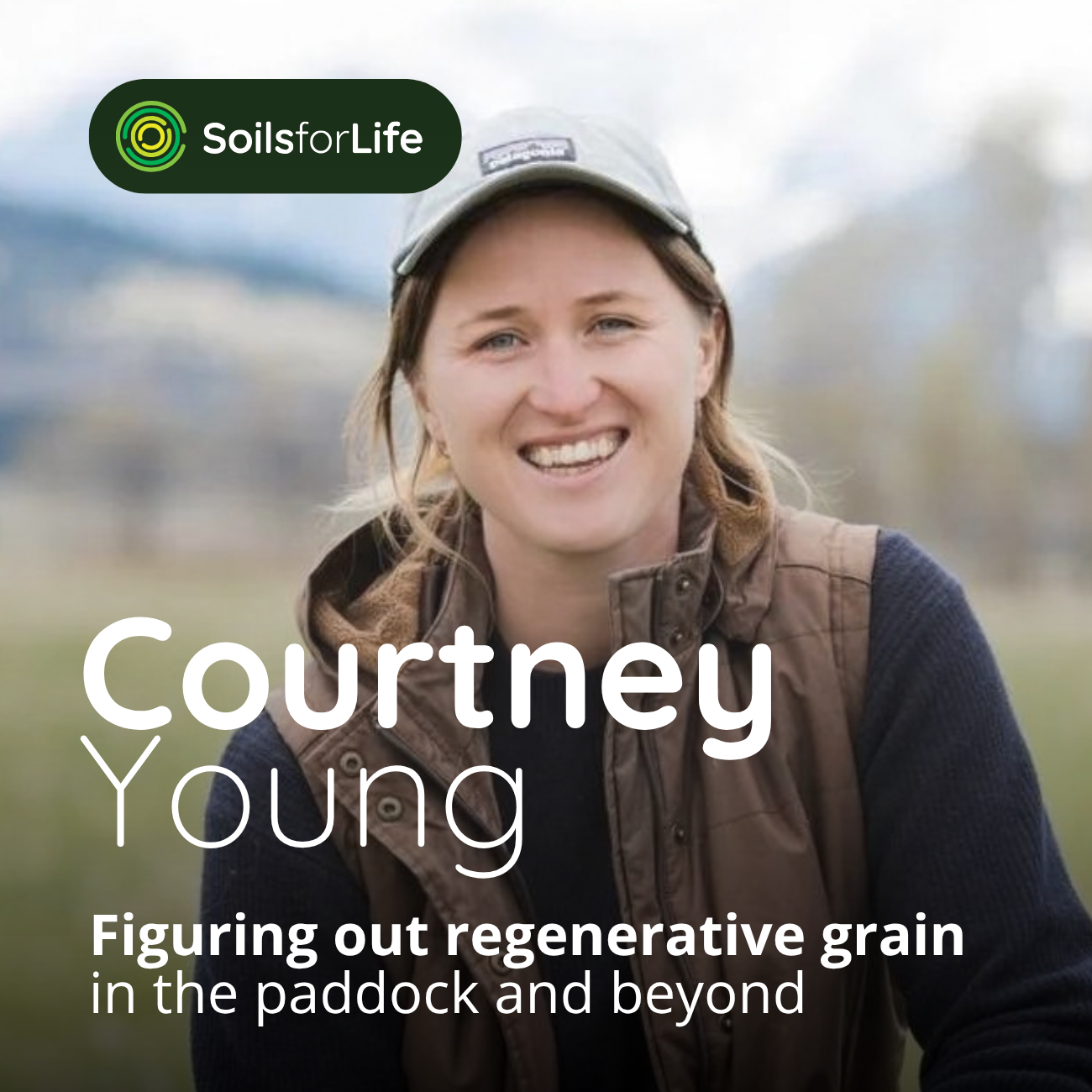
Figuring out regenerative grain in the paddock and beyond, with Courtney Young
Courtney Young farms organic grain with her husband Ian in Rutherglen, Victoria, and is also Soils for Life’s Farmer Learning Manager. In this episode, she talks with Eli about building a farming life from scratch, growing healthy soil and grain, and turning wheat into a value-added business.
In this episode
- How Courtney’s path into farming began, from her dad’s oyster farming on the NSW South Coast, through a disillusioning stint in conservation, to discovering regenerative agriculture
- The economics of getting into farming today, and how Courtney and Ian navigated the challenge of accessing land
- Building soil and crop health on their 100-acre property and the family’s 2,000-acre organic farm at Berrigan, including intercropping wheat with clover and improving grazing management
- The decision to start milling their own flour, turning a commodity crop into a paddock-to-plate product with a loyal following among Melbourne bakers
- How Courtney and Ian test new ideas cheaply and quickly, and “fail fast” rather than risk the whole business
- Soils for Life’s new Cropping Communities program, an eight-location, on-farm and online initiative helping grain growers and mixed farmers interpret soil and plant health data and turn it into action plans
More
Find out more
If you’re interested in the upcoming Cropping Communities training program for growers and cropping advisors, head to soilsforlife.org.au/cropping-communities/
Get in touch
If you have any feedback or questions about this podcast, or suggestions of topics or people you’d like us to include in future episodes, please reach out on social media or via [email protected].
The network underpinning it all: Fungi with Dr Sapphire McMullan-Fisher and Julie Fielder
World Fungus Day is in October and to mark the occasion we spoke with two mycologists – fungi experts – Dr Sapphire McMullan-Fisher and Julie Fielder about this amazing and mostly hidden lifeform.
Sapphire is a lecturer in plant and fungal Ecology at the University of New England and Julie runs consultancy Phytos Environmental in WA, and both are involved with Fungimap, one of Australia’s longest running citizen science organisations. They’ve both also been involved in the recently published book Fungi for Land: A practical guide for land managers, which draws on the work of more than 25 Australian scientists to explain what fungi do in the landscape and how to manage land in ways that support them.
In this conversation we delve into the weird and wonderful world of fungi, from their ancient beginnings almost 400 million years ago as partners to plants, to their incredible and bizarre present day forms. And we discuss how healthy and diverse fungal ecosystems are so deeply interconnected with, and essential for, healthy and resilient soils, plants and people.
More
Mentioned in this episode
- Fungi for Land: A practical guide for land managers – https://fungi4land.com/
- Fun Fungi Ecology – https://www.funfungiecology.com/
- Fungimap – https://fungimap.org.au/
- iNaturalist – https://www.inaturalist.org/
- PhD on metarhizium – https://eprints.qut.edu.au/117674/
If you have any feedback
If you have any feedback or questions about this podcast, or suggestions of topics or people you’d like us to include in future episodes, please reach out on social media or via [email protected].
From feeding animals to feeding biology: Learning to graze differently with David and Ruth Read
About the podcast
David and Ruth Read own and manage Woodcote, a 470 hectare beef cattle trading farm located in East Gippsland, Victoria.
In this episode, we talk about:
- How the Millennium Drought sounded a wake-up call for their farm
- The changes they have made since that time including moving towards higher density grazing, establishment of fencing and water infrastructure to support that
- Shifting to a primarily trading enterprise and refocusing from feeding animals to feeding biology.
Ruth and David also share their enthusiasm for learning and adapting, and share a wealth of resources for people to tap into as they make their own farm learning journey.
David and Ruth featured as case study farmers in Soils for Life’s recently released Practice Guide: Grazing for Soil and Landscape Regeneration. They are also hosting the third of our national series of field days launching the guide. If you’re interested to see their work in action, and hear more about their farming practices – alongside grazing educator Brian Wehlburg – join us on September 15 for a day of on-farm learning.
If you’re unable to attend that event in-person, we’ll also be running an online webinar on September the 2nd with Rod and Katrina Butler, another of the farming families featured in the grazing guide.
More
Resources, links and events from the episode
- Soils for Life Practice Guide: Grazing for Soil and Landscape Regeneration: https://soilsforlife.org.au/practice-guide-grazing-soil-landscape-regeneration/
- Grazing field day: Strategies to build soil and landscape health, 15 September: https://events.humanitix.com/grazing-for-soil-and-landscape-health-field-day
- Grazing Webinar: Getting started with grazing for soil and landscape health: https://events.humanitix.com/grazing-for-soil-and-landscape-health-with-rod-and-katrina-butler
- Woodcote Pty Ltd: https://www.facebook.com/profile.php?id=100057240318507
- Soils for Life’s interview with Grant Williams:https://open.spotify.com/episode/4yQTkVCoaAXNnwPuROxSib?si=rPR1lf6-QkqI_xu3pdL3RQ
Education providers
- RCS Grazing For Profit course: https://www.rcsaustralia.com.au/farming-grazing-for-profit-programs/
- Graeme Hand: https://www.handfortheland.com/
- Dick Richardson: https://www.naturesequity.com.au/
- Jim Elizondo: https://www.rwranching.com/
- KLR Marketing: https://klrmarketing.com.au/
- Joel Williams: https://integratedsoils.com/
If you have any feedback
If you have any feedback or questions about this podcast, or suggestions of topics or people you’d like us to include in future episodes, please reach out on social media or via [email protected].
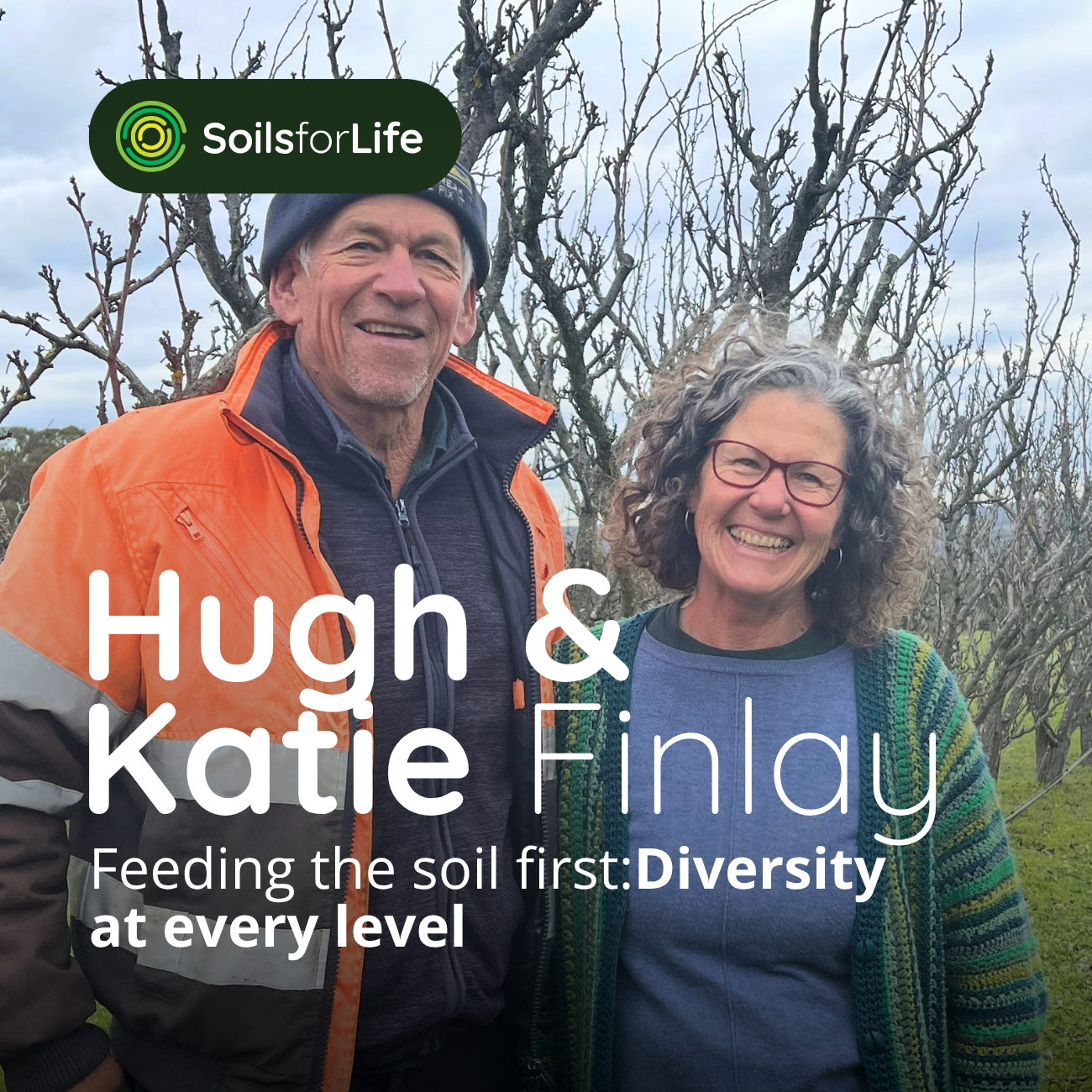
Feeding the soil first: Katie & Hugh Finlay on diversity at every level
Hugh and Katie Finlay manage a 30 hectare farm in Central Victoria, including a commercial stone fruit orchard and fruit tree nursery. The farm also includes a range of small enterprises run by others under the banner of the Harcourt Farming Co-op, including a dairy, market garden, and bush foods plot.
Since 2013, Hugh and Katie also have been educating others in how to grow organic and regenerative fruit through their business, Grow Great Fruit. Perennial horticulture is a fairly new area for me, but this conversation reveals some very familiar themes.
Hugh and Katie focus on the soil above all else, and have seen how taking care of soil biology by adding organic matter, fostering plant diversity, and elimination of all synthetic inputs supports healthy trees that are resilient to pests and disease and require little in the way of pest and disease management.
While many of their strategies are applicable at much larger scale than their now downsized operation, Hugh and Katie are also passionate about the value of smaller scale … about the value of smaller scale enterprises to not only support resilient agricultural businesses, but also connected and thriving regional communities.
Please enjoy this conversation with Hugh and Katie Finlay. And if you’re an orchardist yourself or interested in perennial horticulture, don’t forget to check out our website for all the resources and events that we’re rolling out through our Orchard Resilience project
More
Links and resources
- Grow Great Fruit – https://growgreatfruit.com/
- Harcourt Organic Farming Co-op – https://hofcoop.com.au/about/
- YIMBY Compost – https://www.yimbycompost.com/
If you have feedback, questions, or suggestions for future episodes or guests, we’d love to hear from you – reach out on social media or at [email protected].
Creating diversity above and below the ground: Murray Gomm on cover crops in orchards and vineyards
Murray Gomm is a regenerative farmer and winemaker based near Albany in Western Australia. With his partner Pamela Lincoln, he runs Oranje Tractor Farm, a small organic vineyard and orchard that’s become known for its focus on soil health, biodiversity and carbon-positive farming.
Since the late 1990s, Murray has transformed a degraded property into a thriving, diverse landscape producing wine, fruit, and olive oil. The farm integrates cover crops, composting, mulching, and biological soil management instead of relying on synthetic fertilisers and chemicals.
Murray is a long-time advocate for working with natural systems and is passionate about sharing the message that healthy soils lead to better produce and stronger communities. He regularly speaks on sustainable tourism, carbon farming, and the intersection of agriculture and ecology.
In our conversation, we talk about the value of having a peer group to learn with rather than operating in a vacuum, the role of cover cropping in building diversity and unlocking crop health, soil and plant health monitoring that have helped Murray grow his best tasting peaches ever, and why he now sees himself as a ‘manager of ecological relationships’.
More
Links and resources
- Oranje Tractor Wine and farm
- Soils for Life’s Orchard Resilience project
- The Orchard Underground WA program for commercial fruit and nut growers, delivered by Soils for Life and RegenWA
- Murray has also worked with RegenWA as a cover crop demonstration site
If you have feedback, questions, or suggestions for future episodes or guests, we’d love to hear from you – reach out on social media or at [email protected].
The power of pasture analysis, with Emily House
Emily House began her career as a geologist before an unlikely path led her into ruminant nutrition. After moving to New Zealand, she started working with two vets who wanted to shift from treating livestock disease reactively to preventing it, which meant looking closely at pasture as the major component of the diet.
Emily brings a background in earth science to her work interpreting pasture and soil analysis for animal health and performance. She was part of the team that developed the DietDecoder™, an online tool that assesses the mineral profile of pasture and flags risks to animal health before they show up as clinical problems.
In this episode, she explains why testing the mineral content of pasture goes further than the more familiar measures of dry matter, crude protein and energy that many farmers already use. She talks through real examples, from calcium and milk fever at calving, to copper deficiencies caused by excess sulphur and molybdenum in the soil, and how these mineral gaps can affect everything from hoof health to wool quality. We also discuss the range of responses available once a problem is identified, from targeted supplementation through to adjusting fertiliser regimes and building more mineral-dense pasture through species diversity, along with some striking parallels between what we’re learning about animal nutrition and human health.
In this episode
- Emily’s path from government geologist to ruminant nutrition consultant
- Why pasture mineral testing reveals more than standard dry matter and protein analysis
- How mineral deficiencies and excesses show up in animal health, from milk fever to coat and wool quality
- The DietDecoder™ tool, and how it’s used seasonally around key events like calving and mating
- Addressing mineral imbalances through supplementation, fertiliser decisions and pasture diversity
- Parallels between livestock nutrition and the gaps in our understanding of human nutrition
More
Links and resources
- DietDecoder™ – dietdecoder.nz, including the quote from Dr Pat Poletti referenced in this episode in the FAQ
If you have feedback, questions, or suggestions for future episodes or guests, get in touch on social media or at [email protected]
Regenerative grazing and the key insights of Holistic Management, with Brian Wehlburg
Brian Wehlburg is one of Australia’s most highly regarded Holistic Management educators and a board member of Holistic Management International and the Australian Holistic Management Cooperative. He has delivered training and consulting to businesses, land managers, families, environmental groups and pastoralists all over Australia, as well as in New Zealand, USA and Zimbabwe. He is also a farmer himself, having experience growing crops in Southern Africa, working as a pasture and cattle manager in South West Queensland and managing a mixed-species property in New South Wales.
This is one of the longer conversations we’ve featured on the podcast, but it easily could have been twice this length given the depth of Brian ’s well of knowledge and experience. We talk about his perspective on regenerative grazing, about the key insights of Holistic Management, the deeply held paradigms that often prevent people from seeing these insights, the practical steps that he has seen work to help people get started, and the positive life changes that can result when people succeed.
This episode is one of a series of interviews we’re doing with graziers and educators involved in the development of our recently released guide to grazing for soil and landscape regeneration.
More
Details and registrations for our upcoming grazing field day on 15 July 2026 with Dr Judi Earl at the Curtis family farm in Milmerran Queensland – soilsforlife.org.au/grazing-for-soil-health-field-day-curtis.
Links and resources:
- Brian’s consultancy Inside Outside Management – insideoutsidemgt.com.au
- Soils for Life’s Guide to Grazing for Soil and Landscape Regeneration – soilsforlife.org.au/practice-guide-grazing-soil-landscape-regeneration
- More about Holistic Management from the Savory Institute – savory.global
- Andre Voisin – en.wikipedia.org/wiki/Andr%C3%A9_Voisin
- Jan Smuts, Holism and Evolution – en.wikipedia.org/wiki/Holism_and_Evolution
If you have feedback, questions, or suggestions for future episodes or guests, we’d love to hear from you – reach out on social media or at [email protected].
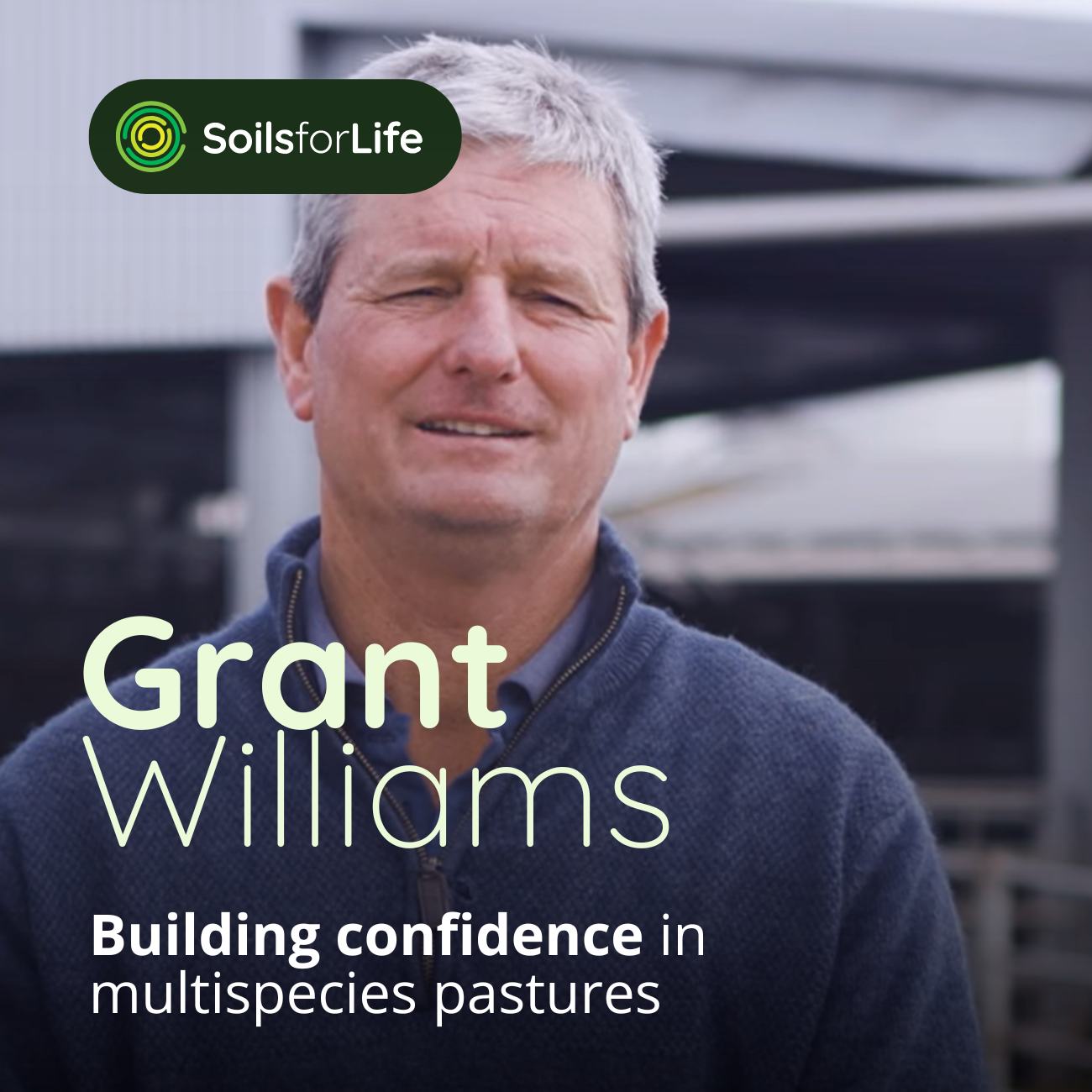
Building confidence in multispecies pastures, with Grant Williams
Grant Williams is a dairy farmer at Hallora in West Gippsland, Victoria, where he and his wife Leesa run Willora Farms – an almost 600-cow operation across 430 hectares. He has been a generous and engaged contributor to the dairy community for many years, and previously served on the Board and as Chair of GippsDairy.
Despite having been an early adopter of robotic milking, Grant describes himself as cautious about making changes on the farm. Over the past decade, however, he has made a change that many dairy farmers wouldn’t dream of, transitioning the whole farm to multispecies pastures, and in the last four years, cutting out all synthetic fertilisers.
In this episode, Grant describes how he ‘fell into’ multispecies pastures, how his early trials didn’t work out the way he hoped, and how he eventually became confident that he could profitably roll out multispecies across the whole farm.
More
Links and resources:
- Soikee machine – soilkee.com.au
- Soils for Life’s dairy resources and activities – soilsforlife.org.au/dairy-resilience-project
If you have feedback, questions, or suggestions for future episodes or guests, we’d love to hear from you – reach out on social media or at [email protected].
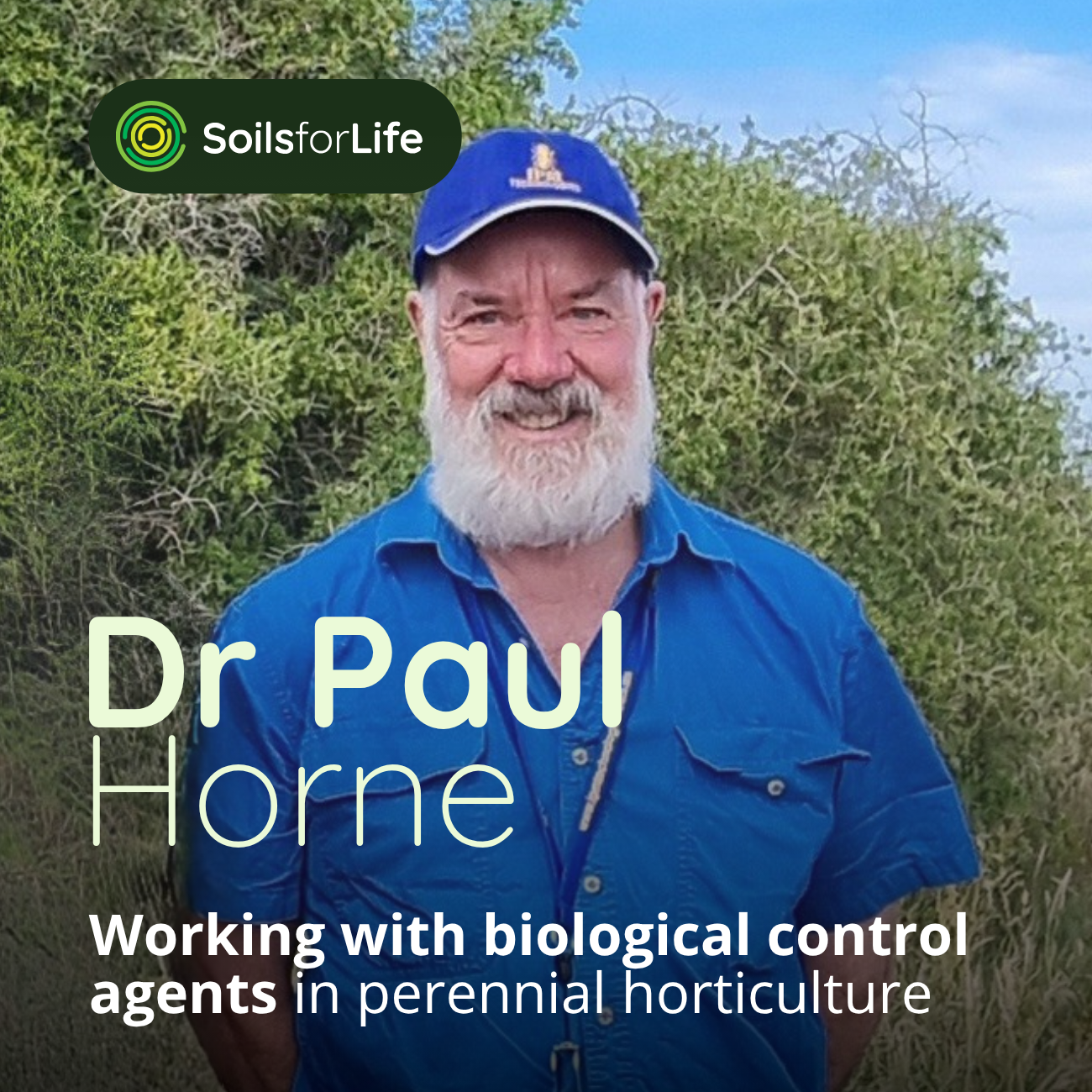
Working with biological control agents in perennial horticulture, with Dr Paul Horne
Dr Paul Horne is an award winning entomologist and founder of integrated pest management consultancy IPM Technologies. He began his career at the Victorian Department of Agriculture in the mid-1980s, his work has been published across scientific journals and industry platforms, and he has written several books on insects and pest management.
Paul’s work focuses on supporting adoption of IPM strategies to manage invertebrate pests in a wide range of crops including cut-flowers, berries, vegetables, tree and vine crops, nurseries, broad-acre crops and pastures.
As our new initiative to support fruit and nut growers kicks off, I wanted to talk with Paul about the state of play with integrated pest management, and what he has found works well to support adoption of IPM in perennial horticulture.
If you’re involved in perennial horticulture, check out our new Orchard Resilience Project. With funding from the Australian Government’s Climate-smart Agriculture Program, we’re working over the next three years with perennial horticulture growers across Australia to strengthen soil health and landscape function in tree and vine crops.
This episode was recorded live from the Grounded festival in Victoria. Enjoy!
More
Links and resources:
- IPM technologies
- Soils for Life Orchard Resilience Project
If you have feedback, questions, or suggestions for future episodes or guests, we’d love to hear from you – reach out on social media or at [email protected].
Managing risk in grazing through safe-to-fail farm trials, with Graeme Hand
Graeme Hand is a holistic land management and grazing educator based near Bairnsdale, Victoria, where he has farmed for more than 35 years. He came to the land via an unlikely route, a decade as an industrial chemist, before applying that scientific background to regenerative agriculture. A Certified Holistic Management educator and Board member of Regenerative Agriculture Network Tasmania, Graeme has been supporting farmers in adopting regenerative grazing techniques since 1996, and has spent the better part of three decades helping farming businesses rebuild topsoil, restore pasture, improve the water cycle and strengthen their resilience to a changing climate.
At the heart of Graeme’s work is a conviction that lasting change on the land starts with the decisions made each day in the paddock, with ‘safe to fail’ trials at the heart of his approach. As Graeme explains in this episode, trials are the key strategy that enables farmers to manage the complexity of biological approaches to grazing. It was a pleasure to record this episode with Graeme, live from the Grounded festival in Victoria, and I hope you enjoy our conversation.
More
Links and resources:
- Hand for the Land: Heaps of resources and advice from Graeme Hand’s holistic land management and training consultancy
- Monitoring ecological indicators of rangeland functional integrity and their relation to biodiversity at local to regional scales: Study mentioned in this episode, authored by David Tongway and others
If you have feedback, questions, or suggestions for future episodes or guests, we’d love to hear from you – reach out on social media or at [email protected].
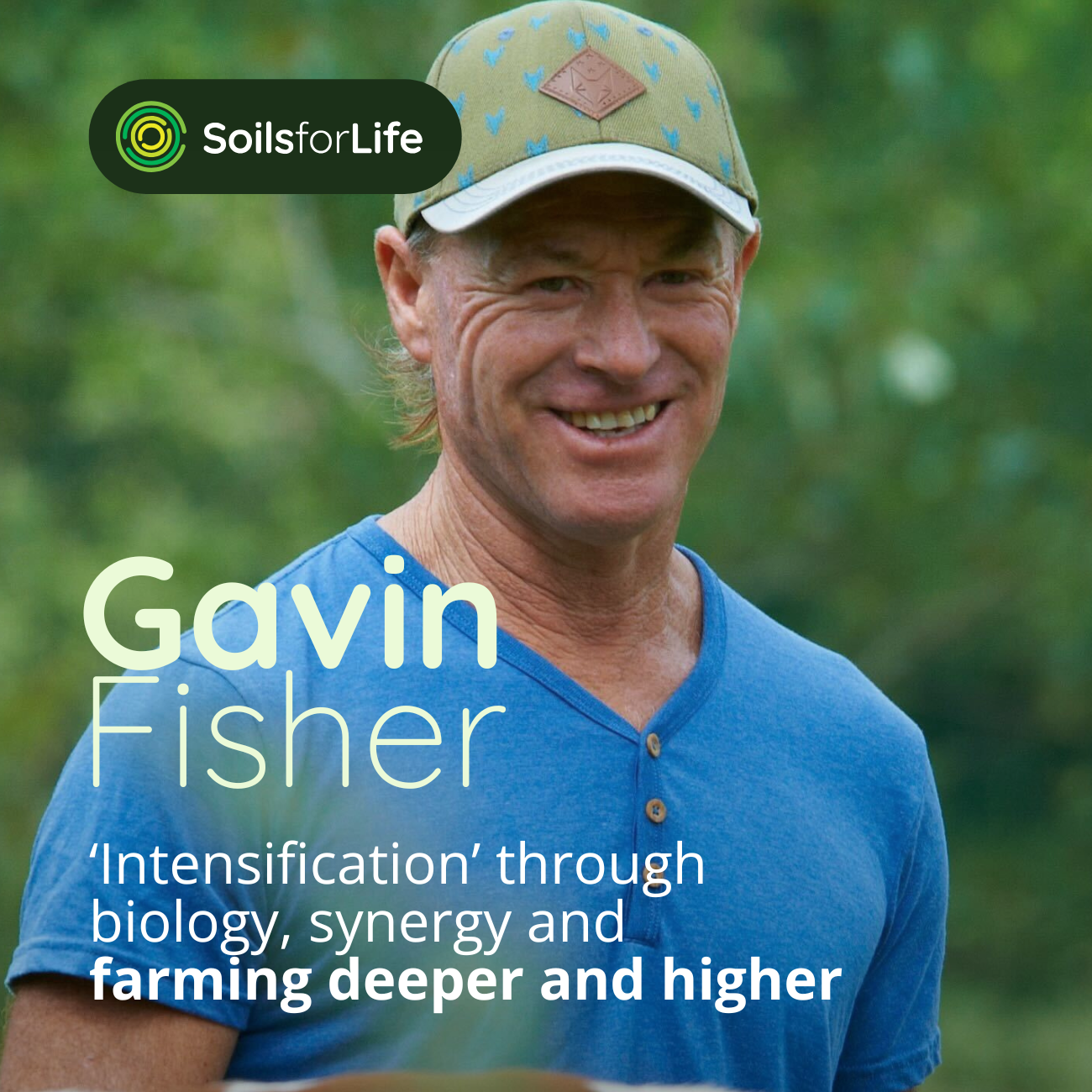
‘Intensification’ through biology, synergy and farming deeper and higher, with Gavin Fisher
This episode was recorded live at the third Grounded Festival at Yan Yan Gurt West farm in Victoria’s Otways. One of my highlights of the festival was hearing from third-generation New Zealand dairy farmer Gavin Fisher. Although, dairy is only the tip of the iceberg of Gavin’s farm. He also raises deer, chickens and ducks, and bees. The pastures are multi-species, but every paddock is also surrounded by diverse plantings of trees and shrubs, including fruit and nut trees, and medicinal plants for the cows.
This is the product of a decades-long process through which Gavin has steadily transformed his family’s farm from a flat, treeless series of paddocks, into a diverse and multi-layered production system. With the principle of biological diversity and synergy at the centre of his vision, and farming deeper and higher rather than expanding his land area, Gavin has created a low cost, minimal input, highly resilient and profitable enterprise that is filled with life:
More
Links and resources:
- Gavin’s Instagram – www.instagram.com/off_the_planet_organics
- Gavin’s LinkedIn – www.linkedin.com/in/gavin-fisher-a28b8280
If you have feedback, questions, or suggestions for future episodes or guests, we’d love to hear from you – reach out on social media or at [email protected].
Tracking milk quality, profit and soil health: A five year regenerative trial, with Claire Buchanan
What happens when a commercial dairy farm runs regenerative and conventional systems side-by-side, and measures the results?
In this episode, Clare Buchanan from Align Farms shares insights from an ongoing trial in Mid Canterbury, New Zealand. Half the farm is managed conventionally, while the other half uses diverse pastures, lower synthetic inputs and a different approach to grazing and stocking. The aim has been to test how these systems perform in the same conditions, across production, environment and profitability.
Clare talks through what they’ve been observing in the five years the trial has been running, including pasture production without synthetic nitrogen, how soil biology is tracking, and what they’ve learned about pasture diversity over time. Early research is also pointing to differences in milk quality, with links between pasture composition and fatty acids and plant compounds in the milk.
Financial performance is a key part of the trial. The regenerative system is currently profitable, but not yet matching the conventional side, largely due to lower stocking rates and production. As input costs shift and the system continues to evolve, that gap is something they’re watching closely.
Clare reflects on what they would do differently, what still isn’t clear, and where there may be opportunities for farmers looking to test similar approaches on their own farms.
More
Links and resources:
- Find out more about the trial and Align Farms here: https://alignfarms.co.nz/
- Lincoln University study, Regenerative Farming Enhances Human Health Benefits of Milk and Yoghurt in New Zealand Dairy Systems, 2025, https://www.mdpi.com/2624-862X/6/4/39
If you have feedback, questions, or suggestions for future episodes or guests, we’d love to hear from you. Reach out on social media or at [email protected].
Rapid response: Managing the nitrogen fertiliser crisis, with Joel Williams
Australia’s fertiliser crisis has been building for weeks as a result of the conflict in the Middle East. Around 60 per cent of Australia’s urea imports travel through the Strait of Hormuz, which has been severely disrupted, leaving shipments stranded and future orders cancelled.
Some reports suggest urea prices have already more than doubled since December 2025, from around US$350 per tonne to US$750, and there are serious doubts about whether any supplies will be available beyond the next few months if the conflict continues.
Even if stock becomes available, the prices are eating into margins, with reports that many growers are choosing to cut production because the economics simply don’t stack up.
The federal government has formed a Fertiliser Supply Working group and responded with a package of measures including new legislation to underwrite the import of emergency fertiliser supplies.
But what can producers themselves do? Today we’re talking to soil and plant health educator Joel Williams about what farmers can do right now to manage this situation on the ground.
More
- Links and resources:
- Soils for Life Cropping Practice Guides
- Joel Williams’ Foliar Nitrogen Course
- GRDC Resources page
If you have feedback, questions, or suggestions for future episodes or guests, we’d love to hear from you – reach out on social media or at [email protected].
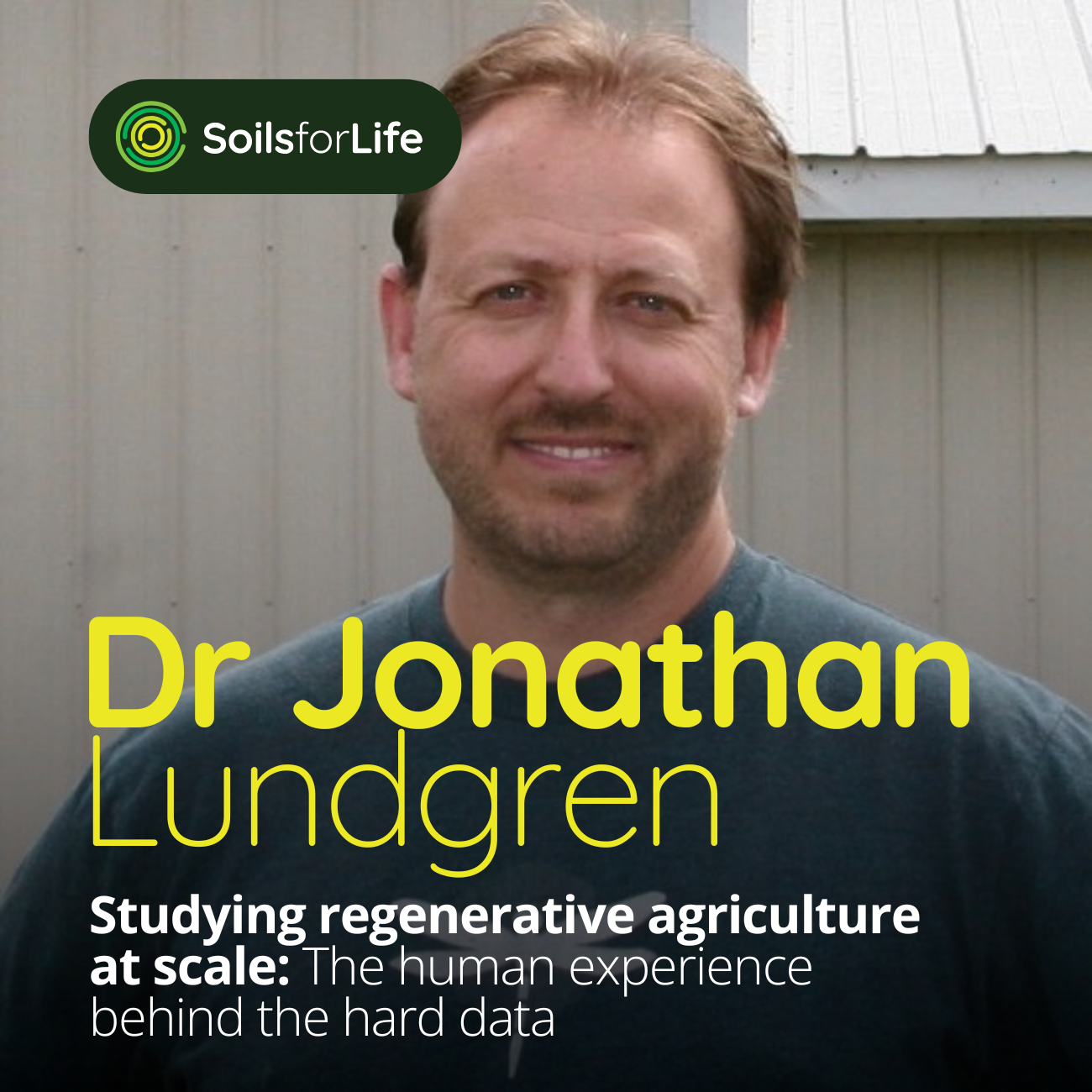
Studying regenerative agriculture at scale: The human experience behind the hard data, with Dr Jonathan Lundgren
Dr Jonathan Lundgren runs 1,000 Farms, the largest and most comprehensive study of regenerative agriculture anywhere in the world. Despite the name, the program now includes more than 2,000 farms across all eco-regions in North America, with a minimum of 500 data types for each farm, including data on production, economics, soil, water, biodiversity, carbon, nutrition and more. The results – according to Jon – are illustrating what farmers themselves have been reporting, that working with natural systems on farms can be as profitable, with greater stability and resilience, improved environmental outcomes and much improved mental and physical health and wellbeing for the farmers.
But that incredible research is just the tip of the iceberg of this conversation. After a highly distinguished scientific career, including a PhD in entomology, more than a decade with the USDA, receiving the Presidential Early Career Award for Science and Engineering, and writing more than 100 peer-reviewed journal articles, Jon pivoted.
He established Ecdysis Foundation, a nonprofit organization based in Estelline, South Dakota, dedicated to advancing regenerative agriculture through relationship-based, independent research, and bought and now runs a farm – Blue Dasher Farm. He has become a passionate advocate for reorienting food and agriculture systems away from centralised corporate commodity chains and back to the farmers on the land, their health and wellbeing, and that of the communities in which they operate. This, he argues, is the pathway to more secure and resilient agriculture, and to realising the true potential of regenerative agriculture to deliver on our most pressing social, economic and environmental issues.
More
-
Further reading:
If you have feedback, questions, or suggestions for future episodes or guests, we’d love to hear from you – reach out on social media or at [email protected].
Nature’s army: Using functional biodiversity for biocontrol in orchards, with Dr Mary Retallack
Dr Mary Retallack is an agricultural scientist, third-generation viticulturist and agroecologist who has spent more than three decades advancing environmental stewardship within agricultural landscapes. She grew up on a fruit block in SA’s Riverland growing grapes, apricots and pears, and now lives on a small vineyard and apple orchard surrounded by native insectary plants in the Adelaide Hills.
Mary is the founder and custodian of the award-winning National EcoVineyards Program, working in collaboration with more than 175 program partners and wine growers across fifteen regions in four states to build functional biodiversity, restore soil health, and reduce reliance on synthetic inputs.
Mary’s PhD research in viticulture and plant protection focused on native insectary ground cover plants and the role they play in supporting natural predators of vineyard pests. Her findings show how functional diversity not only builds ecological health, but delivers economic benefits to growers, and there are heaps of detailed case studies from growers around the country on the EcoVineyards website.
If you’re involved in perennial horticulture, check out our new Orchard Resilience Project. With funding from the Australian Government’s Climate-smart Agriculture Program, we’re working over the next three years with perennial horticulture growers across Australia to strengthen soil health and landscape function in tree and vine crops.
More
Links and resources:
- EcoVineyards Program
- Retallack Ecology
- Soils for Life Orchard Resilience Project
- John Kempf’s Plant Health Pyramid
If you have feedback, questions, or suggestions for future episodes or guests, we’d love to hear from you – reach out on social media or at [email protected].
Milk, the original superfood, with Matthew Evans
Matthew Evans is a chef, farmer, author, food advocate and founder of Australia’s Grounded Festival groundedaustralia.com.au.
Soils for Life is kicking off a new national program working with dairy farmers around the country, and we thought it was the perfect time to talk to Matthew about his most recent book, ‘Milk: The truth, the lies and the unbelievable story of the original superfood’.
We discuss some of the debates around dairy, including lactose intolerance, nutrition, and sustainability and how regenerative practices on farms can improve both soil and milk quality.
More
You’ll hear about:
- The biology of milk, and how evolution has designed milk to be the perfect food source for nourishing and protecting the young
- The history of humans drinking milk from other animals, and why it became so central to many cultures
- Health benefits of milk, from complex proteins to compounds that support immunity and brain health
- How plant diversity and soil health influence milk quality, including omega-3 / omega-6 ratios
- Comparing dairy versus milk alternatives
Interview
Navigating soil science, with Dr Susan Orgill
Dr Susan Orgill is Chief Scientist at Impact Ag Australia and a leading soil scientist with more than 20 years’ experience. She specialises in soil health, carbon farming, and regenerative agriculture, delivering science-based strategies that improve farm resilience, natural capital, and climate outcomes across research, policy, and sustainability initiatives.
Suz has long been a friend of Soils for Life. She’s one of the most interesting and impressive soil scientists working in agriculture, and we’ve been meaning to get her on the podcast for some time. So please enjoy this conversation with the one and only Suz Orgill.
More
Mentioned in this episode:
- Paper mentioned by Dr Susan Orgill: “Placing cropping systems under suboptimal phosphorus conditions promotes plant nutrient acquisition and microbial carbon supply without compromising biomass“
- Frank Ashwood photography from Soils for Life case study farms
- Aviva Reed visual ecologist – avivareed.com
Short
Earning the right to reduce pesticides: Building plant resilience with Brad Campbell
Western Australian farmer Brad Campbell has spent years refining his mixed cropping system to build healthier, more resilient plants and reduce reliance on synthetic inputs. Over time, he’s cut out routine fungicides and insecticides, moved away from chemical seed treatments, and now only uses pesticides strategically when needed.
In this conversation, Brad talks about how targeted plant nutrition, sap testing and careful observation are helping him make management decisions and improve crop health.
Brad shares how his family’s early shift toward biological farming set the foundation for his approach, why monitoring matters more than ever, and what he means when he says you have to earn the right to reduce pesticides.
Brad’s story features in our Practice Guide on Building Plant Resilience to Pests and Diseases, which brings together insights from farmers and experts across Australia. You’ll find it at soilsforlife.org.au
In this episode
- Why Brad says you need to “earn the right” to reduce pesticides
- How sap and tissue testing inform his nutrition decisions
- Using observation and small-scale trials to guide change
- What’s changed in soil function and disease pressure over time
- Lessons from experimenting, learning and staying profitable
More
Resources
- Practice Guide: Building plant resilience to pests and diseases (coming soon to soilsforlife.org.au)
- Explore more cropping practice guides and farmer stories at soilsforlife.org.au
- Brad mentioned a course by Neil Kinsey: https://kinseyag.com/
- Brad also mentioned a course by Arden Anderson: https://soillearningcenter.com/product/sustainable-agriculture-course/
This short episode of the Soils for Life Podcast was hosted by Eli Court and produced by Chris Wieffering.
If you enjoyed this episode, please rate and share it, and subscribe to hear more stories from Australian farmers building soil and landscape resilience.
Short
From problem paddocks to healthy soils, multispecies with Grant Sims
This episode of the Soils for Life podcast is part of our series of mini-episodes with farmers profiled in our series of cropping practice guides.
In this short episode, Eli Court chats with Victorian farmer Grant Sims about how multispecies cover cropping has transformed his mixed farming system at Pine Grove near Lockington. After moving away from synthetic fertilisers, fungicides and insecticides, Grant began experimenting with diverse seed mixes to bring more life back into his soils.
He explains how integrating livestock with multispecies crops built soil structure, reduced weed pressure and improved resilience during tough seasons. Grant also shares what he’s learned about designing mixes for different paddocks, fixing nitrogen through cover crops, and cutting input costs without sacrificing productivity.
Along the way, he’s learnt through trial and error from experiences like underestimating the importance of weed control before sowing and trying to “add biology” to soils that weren’t yet ready for it. He talks openly about these lessons, as well as his current experiment sowing his whole farm with zero nitrogen for the first time.
Highlights
- How Grant “stumbled into” multispecies crop mixes and scaled them over time
- The role of livestock grazing in improving performance and reducing risk
- How cover crops can build fertility, especially nitrogen fixation and phosphorus unlock
- Lessons he’s learned, e.g. weed control, applying biology to soils not ready for it
- Taking the leap: sowing with zero nitrogen and watching the system work
- What he wishes he’d known earlier
More
Resources & links
Read the full Practice Guide on Multispecies Cover Cropping: https://soilsforlife.org.au/practice-guide-multispecies-cropping/
Down Under Covers: https://www.downundercovers.com/
If you enjoyed this episode, please rate & review it on your podcast app and share it with others. Email us with feedback or suggestions for future episodes at [email protected] and subscribe to the Soils for Life newsletter to find out the latest.
Short
Moving to a low risk, low input system one step at a time, with Steven Ford
This episode of the Soils for Life podcast is part of our series of mini-episodes with farmers profiled in our series of cropping practice guides.
In this episode we talk with Steven Ford. Steven and his wife Kelly have been farming near Williams, Western Australia, for 16 years. After 10 years working as a livestock agent, Steven returned to the family farm in 2008. Being advised to use a new expensive chemical seed treatment prompted Steven to rethink and do some research. In 2016, he decided to transition their cropping system away from treated seed, synthetic fertilisers, insecticides and fungicides, and he also began to look at ways to reduce the need for herbicide.
Steven’s story shows that reducing herbicides is just one outcome of his holistic approach to building soil health and reducing reliance on inputs. We discuss encouraging roots to go exploring deeper in the soil profile, using livestock as the ultimate insurance for transitioning to a lower input, lower risk system, making strategic decisions about when to intervene to address pests or disease, getting off the ‘spending more to make more’ treadmill, and keeping true to the course when the confidence takes a knock.
More
Read the full Practice Guide on Reducing Herbicides
Get in touch – [email protected]
Subscribe to our newsletter – soilsforlife.org.au/the-newsletter
Interview
“We are walking ecosystems”: Our symbiotic relationships with microbes, with Jake Robinson
Jake Robinson is a microbial ecologist and researcher whose career spans parasitology, symbiosis, and the study of invisible communities of life that shape the health of humans, animals, plants and ecosystems. He is the author of Invisible Friends: How Microbes Shape Our Lives and the World Around Us, and his work explores the connections between soil health, gut health and mental health.
We spoke with Jake about the brutal world of microbe warfare that’s going on every day inside our bodies, what it means to see humans and plants as “walking ecosystems”, how microbes underpin communication between the gut and the brain, the importance of exposure to microbes for training our immune system, how farming practices can influence the nutritional value of our food, and just how much of this invisible world remains unknown to science.
More
Jake is the brains behind Soil Yourself September, a series of talks from speakers around the world on the connections between soil health, gut health and mental health. Find out more at https://www.jakemrobinson.com/sys
Get in touch – [email protected]
Subscribe to our newsletter – soilsforlife.org.au/the-newsletter
More about Jake Robinson – https://www.jakemrobinson.com/
Short
Getting foliars right, with Tom Robinson
This episode is part of a series of short conversations with the farmers profiled in our cropping practice guides.
For Tom Robinson, foliar sprays aren’t a magic fix, but they’ve become a game-changer. Guided by sap testing and years of trialling, they’re helping him hit crop nutrition targets and lift grain performance while fitting into a broader soil health strategy.
In this episode, Tom shares how he’s shifted from the odd zinc spray to a targeted program guided by regular sap testing, hitting critical growth stages in wheat, lentils, and canola. We talk through the practicalities – from making his own trace element mixes on-farm to jar testing, timing sprays for maximum uptake, and deciding when to include extras like seaweed or compost extracts.
Tom also explains how foliar nutrition fits with other practices like zero-till, controlled traffic, and tactical livestock grazing, and the results he’s seen in grain quality, germination, and reduced pesticide use.
Whether you’re already using foliars or just curious about where they might fit in your system, you’ll get practical tips and lessons learned from years of trial, observation, and adjustment – all aimed at building plant health and farm resilience.
More
Read the full practice guide on using foliars at soilsforlife.org.au/practice-guide-foliar-applications/
Get in touch – [email protected]
Subscribe to our newsletter – soilsforlife.org.au/the-newsletter
Interview
Navigating Uncertainty: Practical Paths to Resilient Farming Systems, with Nicole Masters
Nicole Masters is an agroecologist, educator and author with decades of experience working alongside farmers and land managers across Australia, New Zealand, North America and beyond. She is formally trained in soil science, organisational learning and adult education, and is known for taking a practical, systems-based approach to regenerating land and building resilient farm businesses. Nicole is the founder of Integrity Soils and author of For the Love of Soil.
We caught up with Nicole ahead of her forthcoming visit to Australia in September to talk about navigating the overwhelm of managing complex and uncertain agroecological systems, implementing new practices safely, the toolkit for diagnosing and dealing with limitations in your system, the value of coaching and peer support, and ultimately, strategies for building healthy, resilient farming systems.
If you’ve enjoyed this podcast, leave us a comment or a like! It helps us to reach others.
More
Get in touch – [email protected]
Subscribe to our newsletter – soilsforlife.org.au/the-newsletter
Mentioned in this episode:
- Integrity Soils – integritysoils.co.nz
- CREATE (Coaching Regenerative Experts in Agriculture for Tomorrow) – https://www.integritysoils.co.nz/create
- Book for Nicole’s Soil Health Masterclass, at Tresavale Farm, Gympie, Qld – https://integritysoils.com/products/masterclass-aus
- A chat with Sam Vincent, author of ‘My Father and Other Animals’ – soilsforlife.org.au/my-father-and-other-animals-a-chat-with-sam-vincent/
- Jonathan Lundgren’s 1,000 Farms initiative – www.ecdysis.bio/featured-project
Soils for Life work with Nicole Masters:
- Masterclass recap: Rethinking what healthy soil looks like: A blog reflection on Nicole Masters’ intensive masterclass in Orange, exploring how we’ve normalised degraded landscapes and how to start seeing soil health differently. soilsforlife.org.au/nicole-masters-masterclass
- Webinar: Tracking soil health with Nicole Masters: Nicole works with three Australian grain growers to explore soil health using the Soilmentor app — demonstrating practical, visual soil tests like rhizosheath assessment, infiltration and rooting depth. soilsforlife.org.au/tracking-soil-health-with-nicole-masters
- Webinar replay: Soil health in practice: Watch the full July 2024 webinar with Nicole Masters and see how soil indicators are used to guide decision-making on-farm. soilsforlife.org.au/tracking-soil-health-with-nicole-masters-webinar
Short
Feeding cane by building biology: Michael Waring on soil health and nitrogen cycling in the tropics
This is the first in a series of short episodes we’ll be releasing over the coming months featuring farmers profiled in our series of regenerative cropping Practice Guides. Check out the full suite of guides at www.soilsforlife.org.au.
Michael Waring is a North Queensland sugarcane grower with decades of experience improving nitrogen cycling and soil health. Michael walks us through his journey from adopting controlled traffic, multispecies cover cropping, reduced tillage, and biological inputs.
Michael shares the nitty-gritty of how he trialled, and eventually achieved, a multispecies cover crop mix that can survive the tropics’ brutal wet season. He explains how he’s cut nitrogen rates dramatically without sacrificing yield, and how new biological tools are helping him unlock phosphorus sitting in the soil. For sugarcane growers, and any farmer wanting to cut costs, reduce runoff and build a healthier farming system, this episode is for you.
We talk about what worked on-farm: the tweaks, the failures, and the long game of testing ideas until they stick. Michael’s message is simple – there’s no silver bullet, but there are simple steps you can take to get started.
Read the full Practice Guide on Improving Nitrogen Cycling and Efficiencies at soilsforlife.org.au
If you’ve enjoyed this podcast, leave us a comment or a like! It helps us to reach others.
More
This podcast is brought to you by Soils for Life, produced by Chris Wieffering and hosted by Eli Court.
- Sign up to the Soils for Life newsletter – soilsforlife.org.au/the-newsletter/
- Get in touch – [email protected]
Interview
Letting the microbial superstars do the work, simple steps to build soil biology, with Dr Mary Cole
Dr Mary Cole has spent more than 40 years working with the microbial life that underpins healthy soil. In this episode, she shares what she’s learned from a career in plant pathology and soil microbiology, and from farming using compost products, aeration and no synthetic inputs on her own property in Gippsland Victoria.
Mary explains how simple practices like aeration, compost, and soil and plant observation can make a big difference to soil function. She talks through what happens when we disturb soil biology, how to get started on improving microbial life, and why she believes we should all be working with, not against, the life beneath our feet.
In this episode, you’ll hear about:
- What mycorrhizal fungi actually do, and why they matter
- How biology-first farming reduces the need for inputs
- Monitoring tips for farmers who want to learn more about what’s going on underground
- Why Mary suggests starting with your worst paddock, not their best
- Reflections on 50 years of biological farming, and what she wishes more people knew
More
This podcast is brought to you by Soils for Life, produced by Chris Wieffering and hosted by Eli Court.
- Sign up to the Soils for Life newsletter – soilsforlife.org.au/the-newsletter/
- Get in touch – [email protected]
Links and resources:
- AgPath (Mary’s consulting and training organisation)
- Our video on brewing biofertiliser: Watch now
- Our podcast episode on compost: Listen
- Other episodes on soil biology: Planting with purpose, Diversity is king
Episode 11
The farming communities restoring natural water cycles — one catchment at a time
Australia has often been described as a land of droughts and flooding rains. But what we don’t often hear is that, for millennia, the land had a remarkable ability to regulate itself — through healthy ecology and the natural water cycle.
Since European settlement, however, we’ve seen a steady decline in soil health and water-holding capacity across much of the country. The rivers don’t flow like they used to, and the land struggles to bounce back from the extremes of flood and drought. The solution is to help restore nature’s ecological systems of water and nutrient cycling.
In this episode, we hear from two farmers who are restoring these natural water regulating systems, rehydrating their landscapes — transforming degraded paddocks into thriving ecosystems. They’ve embraced techniques that slow, spread, and sink water back into the ground — reviving their soils, crops, and communities.
And they’re not alone.
Across Australia, groups of farmers are coming together to restore entire catchments. Programs like the Mulloon Rehydration Initiative are proving that when we work with nature — not against it — we can regenerate not just one farm, but the broader ecosystems they’re part of.
More
This podcast was produced by the Grow Love Project in collaboration with Soils for Life. The Communities of Practice Project is jointly funded through the Australian Government’s Future Drought Fund, Mulloon Institute and Soils for Life.
Sign up to the Soils for Life newsletter – soilsforlife.org.au/the-newsletter/
Get in touch – [email protected]
Mentioned in this episode:
- Mulloon Rehydration Initiative – mullooninstitute.org/projects/mulloon-rehydration-initiative/
- Danthonia Bruderhof Community – bruderhof.com/danthonia
- Mulloon Institute – mullooninstitute.org/
- Laura Norman, US Geological Survey – www.usgs.gov/staff-profiles/laura-m-norman
- Mulloon Institute Community of Practice Project – mullooninstitute.org/learning-events/communities-of-practice/
- Soils for Life case study on Danthonia Bruderhof and Community of Practice project – soilsforlife.org.au/landscape-rehydration/
Interview
Farmers helping farmers, with VicNoTill President Mick Gooden
Mick Gooden runs Old Man Creek Bull Farm near Wagga Wagga in NSW and is President of farmer group Vic No Till.
In this episode, Eli and Mick chat about the value of having a supportive group of peers around you, the links between soil health and human health, the importance of pulling up and taking the time for observation and reflection, transitioning cropping systems profitably, leveraging the power of working with nature, and how to communicate the opportunity in agriculture as a solution to many of our biggest challenges. And we discover how a NSW cattleman ended up President of a Victorian cropping group.
More
Sign up to the Soils for Life newsletter – soilsforlife.org.au/the-newsletter/
Get in touch – [email protected]
Find out more about Mick and Vic No Till:
- Soils for Life Willowlee case study – soilsforlife.org.au/willowlee
- Soils for Life 8 Families Case study – soilsforlife.org.au/the-8-families-group
- Vic No Till – vicnotill.com.au
Other Soils for Life resources mentioned in this episode:
- Integrating livestock guide – coming soon…
- All practice guides – soilsforlife.org.au/cropping-resilience/#resources
Also mentioned
- Brian Wehlburg, Holistic Management educator – insideoutsidemgt.com.au
- Stacey Curcio, Nutritionist – cultivatingwellness.com.au
- Alejandro Carillo, Mexican rancher – instagram.com/p/DLGMlCnRFcg
- John Kempf podcast – advancingecoag.com/podcasts
- Groundswell UK – groundswellag.com
- Drawdown, by Paul Hawken – drawdown.org/the-book
Thanks for listening!
Interview
The ‘mad bastard’ growing veggies for Sydney’s top restaurants, with Phil Lavers
Phil Lavers is passionate about good food. He runs Moonacres, a 140 acre fruit and vegetable farm in the NSW Southern Highlands, and sells his award-winning certified organic produce direct to some of Sydney’s best restaurants.
Phil is not a guy to beat around the bush. He sees big problems with typical practices in fruit and vegetable farming and the impacts those practices have on the soil, the environment and our health. A relentless experimenter, Phil is determined to find ways to do things better.
In this episode we talk about weaning off the rotary hoe, managing weeds, keeping bare soil to an absolute minimum with annual vegetable crops, how to grow the best tasting silverbeet, valuing good food, being a ‘sugar daddy’ for soil microbes, cover cropping and stealing the microbiome from cover crops to grow cash crops.
More
Head to soilsforlife.org.au to find out more about our work.
If you’re finding value in the Soils for Life podcast, please consider donating to help us continue sharing stories and knowledge from farmers. As a non-profit organisation, we rely on support from generous donors, so please consider making a donation via soilsforlife.org.au/donate. Of course, we understand that not everyone has the means to support us financially – you can also help by rating and reviewing us on Spotify, Apple Podcasts or wherever you listen.
If you have feedback, or suggestions of people or topics we should cover, you can reach us at [email protected], we love hearing from you. Thanks for listening.
Links and resources
About Phil and Moonacres
- Moonacres website – Moonacres Kitchen – for more information about whole of operation, farm tours, training opportunities and markets where you can find their produce.
- Moonacres – Heart and Soil Episode #1 youtube channel link
- Organically certified – can’t see by whom he is certified
Other references from the episode:
- https://www.facebook.com/RailwayStMarketMossVale/
- Roller Crimper Roller Crimper Blueprints – Rodale Institute
- Austrian weeding plough
- Southern Highlands on the Grow Inc GROW – Southern Highlands
Further learning:
To gain some deeper understanding about multispecies crops Phil is using in his soil health building rotations refer to our Soils for Life Multispecies practice guide Practice Guide: Multispecies Cropping – Soils For Life
Interview
Making decisions in the dry, with Martin Royds
With record dry conditions across eastern Australia and many of you facing difficult decisions, we wanted to have a chat with Braidwood farmer Martin Royds to share his thoughts and experiences with making decisions in the dry, and coping with the emotional toll of seeing the landscape go backwards.
Read more about Martin Royds’ approach to building landscape resilience – https://soilsforlife.org.au/observing-resilience-at-jillamatong/
Martin speaks in the episode about his approach to managing grazing livestock during drought, which is informed by Holistic Management techniques. You can learn more about Holistic Management via:
- Workshops and other events run by the Australian Holistic Management Cooperative – https://holisticmanagement.au/events.php
- The Savory Institute – https://savory.global/holistic-management/
- Online courses run by The Savory Institute – https://savory.shop/en-au/collections/online-courses
More
Other links and resources that may be useful include:
- Resource Consulting Services (RC) events and courses – https://www.rcsaustralia.com.au/
- Inside Outside Management, Brian Wehlburg, Holistic Management educator – https://www.facebook.com/insideoutsidemanagement/
- Decision Design Hub, Helen Lewis, Holistic Management educator – https://decisiondesignhub.com.au/
- AIMS (Agricultural Information & Monitoring Services), Dr Judy Earl – https://aimsag.com.au/
- Southern Blue Regenerative, Glen Chapman, Holistic Management educator – https://www.southernblue.com.au/
If you or someone you know is struggling, please reach out. Rural Aid support line (1300 175 594), Lifeline (13 11 14), and Beyond Blue (1300 22 4636) offer free, confidential support. The National Centre for Farmer Health also provides a wide range of resources – https://farmerhealth.org.au/support-hub#mental-health-support-farmers.
Get in touch with us a [email protected].
* Note, in this episode when Martin refers to the “1983 drought” he was referring to the drought that ended in 1983.
Episode 10
Diversity is king: How four dairy farmers are building profitability and resilience with multispecies pastures
Can dairy systems support soil health, productivity and profitability at the same time?
In this episode we meet four dairy farmers who are exploring that question. Kate Mirams, Simon Schulz, Sandra Jefford and Chris Eggert share their experiences with introducing diversity into their pastures and farming systems—what motivated them, what they tried, and what they’ve learned so far.
We also hear from pasture scientist Anna Thomson with her insights from current research into multispecies pastures, including how they’re performing under real-world conditions and what that might mean for animal health, climate resilience and farm inputs.
You’ll hear about:
- The trial that gave Kate confidence to rethink her approach to nitrogen and massively reduce synthetic nitrogen applications while increasing production
- How Simon is combining pasture diversity with new tillage methods and enterprise stacking
- What Sandra is learning from sap tests, shelterbelt plantings and mixed perennial pastures
- Why Chris first turned to organics, and what he’s observed about soil and plant health since
- Anna’s research into growth, resilience and methane in multispecies swards
- What farmers are finding when they start measuring BRIX
Whether you’re already experimenting or just interested in what others are finding, this episode offers a window into paths being explored in the Australian dairy industry.
More
Resources and links mentioned in this episode:
Farmers
- Simon Schulz – https://schulzorganicdairy.com.au/
- Chris Eggert – https://oxhillorganics.com.au/
- Sandra Jefford – https://www.wilandrafarms.com.au/
Soil and regenerative agriculture resources
- Kate’s presentation to the Dairy Australia Grounds for Growth Conference in March 2025 on the results of her trial
- Nicole Masters – Cited by Simon Schultz as an influential voice on soil biology. Check out her book For the Love of Soil or Integrity Soils for more resources.
- Jade Killoran from Healthy Farming Systems – Mentioned by Kate in relation to soil repair trials post-laser grading.
- Shelterbelt planning with productive and medicinal trees – Sandra’s system of mixed-species planting for shade, fodder and natural worming. Agroforestry or shelterbelt design resources:
- Agroforestry in Australia: https://www.agroforestry.org.au
- EverGraze shelterbelt info: https://www.evergraze.com.au/library-content/shelterbelt-design-and-benefits/
Trials and benchmarking tools
- Victorian Dairy Farm Monitor Project – Kate Mirams mentions using this to compare pasture consumption and input efficiency.
- Soil moisture probes – Used to track root depth and water uptake under different pasture mixes.
- Sap analysis and BRIX meters – Sandra Jefford and Kate Mirams both use these to monitor plant sugars and infer animal nutrition and productivity.
This episode was hosted and produced by Susannah Kable from the Grow Love Project, in collaboration with Soils for Life.
Head to the Soils for Life website (soilsforlife.org.au) to find out more about our work, and if you like what you hear don’t forget to rate and review our podcast. Every review helps to make our podcast easier for others to find.
If you have feedback, or suggestions of people or topics we should cover, you can reach us at [email protected], we love hearing from you. Thanks for listening.
Interview
Farming for what matters, putting profit and human wellbeing before yield, with Gabe Brown
In this episode we talk with Gabe Brown, a farmer and educator from North Dakota. Gabe and his family run Brown’s Ranch, a 6, 000 acre operation that’s become a model for regenerating land.
After years of tough seasons and crop failures, Gabe recognized a need to build a farming system that works with nature instead of against it. Through no till, cover crops, diverse rotations and integrating multi species livestock, he restored soil health, boosted resilience and almost eliminated the need for synthetic inputs. Gabe advocates for ‘profit over yield’ and says that farming with nature is the way to get there.
Beyond his own farm, Gabe’s helped thousands of farmers transition to regenerative practices through his work with Understanding Ag, the Soil Health Academy, and his book Dirt to Soil. We hope you enjoy this conversation with Gabe Brown.
This episode was hosted by Eli Court and produced by the Grow Love Project.
More
Head to soilsforlife.org.au to find out more about our work, and if you like what you hear don’t forget to rate and review our podcast. Every review helps to make our podcast easier for others to find.
If you have feedback, or suggestions of people or topics we should cover, you can reach us at [email protected], we love hearing from you. Thanks for listening.
Mentioned in this episode:
- Gabe’s book ‘Dirt to Soil’
- Understanding Ag
- Regenified
- The Soil Health Academy
- Research by Stefan van Vliet. Listen to our podcast episode with Dr van Vliet.
Interview
Restoring the water cycle on the Monaro, with Charlie Maslin
Over the years we’ve heard from many farmers about creeks and rivers that are severely eroded, and landscapes that have lost their ability to absorb and store water. In big rain events water runs off and is gone in a matter of days or even hours. We’ve become accustomed to this, but what did those landscapes look and function like 100 years ago, or 200 years ago? Can farmers restore creeks and landscapes to their full potential, holding on to water for longer and utilising better?
This episode is a collaborative effort with our friends at Mulloon Institute as part of their Communities of Practice Project. In it, we chat with Charlie Maslin, an amazing land steward raising cattle and sheep on the Monaro in New South Wales.
Charlie took us on his journey of landscape repair, which began with a change in grazing practices to improve ground cover, and then moved on to focus on repairing his degraded waterways to rehydrate the landscape and support a thriving and productive agro-ecosystem.
We first visited Charlie’s farm in 2021 and the land was alive with water, grass, frogs, birds, insects and platypuses playing in the waterways. The effects of his steady, thoughtful changes to his management approach were crystal clear, and we’re delighted to share his story in this episode. Enjoy.
More
This episode was hosted by Eli Court and produced by the Grow Love Project. The Communities of Practice Project is jointly funded through the Australian Government’s Future Drought Fund, Mulloon Institute and Soils for Life.
Head to the Soils for Life website to find out more about our work, and if you like what you hear don’t forget to rate and review our podcast. Every review helps to make our podcast easier for others to find.
If you have feedback, or suggestions of people or topics we should cover, you can reach us at [email protected], we love hearing from you. Thanks for listening.
You can read our case study Charlie Maslin’s farm here
Find out more about the ‘Communities of Practice Project here
Interview
Planting with purpose, with Jill Clapperton
Jill Clapperton is a farmer and applied rhizosphere ecologist. She grows crops with integrated livestock in Kansas in the U.S. and advises farmers the world over. Talking with Jill was eye opening and fun. We go big talking about gaia theory and the interconnectedness of all life on Earth. But we mostly dive deep into the fascinating ecological communities that plants create above and below the ground.
As Jill explains, plants are not passive. They are purposeful masters of their own fates, wielding chemical arsenals and mustering armies of microbes to secure their survival. And if we plant with purpose, we can harness the incredible power of plants to create farming systems that are productive, resilient and great for the soil and our health.
More
This episode was hosted by Eli Court, and produced by Soils for Life and the GrowLove project. Head to the Soils for Life website (www.soilsforlife.org.au) to find out more about our work.
If you like what you hear, don’t forget to rate and review our podcast. Every review helps to make our podcast easier for others to find. If you have feedback or suggestions of people or topics we should cover, you can reach us at [email protected]. We love hearing from you. Thanks for listening!
Find out more about Jill Clapperton at www.rhizoterra.com/
Check out the Grounded Festival in Cygnet Tasmania on 4-5 December 2024 – details and tickets via groundedaustralia.com.au/
Other people mentioned in this podcast:
– Felice Jacka OAM (foodandmoodcentre.com.au/team/felice-jacka/).
– Dan Kittredge (www.bionutrientinstitute.org/meetdan).
– An article on Lynn Margulis and James Lovelock, and their development of gaia theory (www.abc.net.au/news/science/2022-08-06/james-lovelock-legacy-gaia-climate-science-lynn-margulis/101297574).
– Anna Krzywoszynska, the Finnish researcher at the University of Oulu whose name Jill didn’t dare try to pronounce (www.oulu.fi/en/researchers/anna-krzywoszynska).
– Grant Sims, Soils for Life case study farmer (www.downundercovers.com/about), who was recently featured in our Multispecies Cover Cropping Practice Guide (soilsforlife.org.au/practice-guide-multispecies-cropping/).
Interview
Behind the scenes of Goodies Farm, with Penny Goodwin
Taking the first steps into regenerative agriculture can be intimidating. In this episode of the Soils for Life podcast, Eli Court has a chat with Penny Goodwin from Goodies Farm in Kendenup, WA
Goodies Farm grows an incredible variety of crops, with minimal inputs, and is an integral part of the south west WA food system.
While things can look nice and shiny on the outside, Penny very generously shares the ups and downs of their journey to become better stewards of the land and the soil.
We hope you enjoy this episode!
Interview
Regenerative trailblazers share their stories from the Soil Stewardship Summit
Ever wondered about regenerative agriculture and the impacts it can have on farmers? Join us as we learn about real life experiences shared by seasoned farmers at the recent Soil Stewardship Summit near Yass, NSW. Over two enlightening days, participants explored the concept of regenerative agriculture, discussing key topics such as tapping into indigenous wisdom, enhancing drought resilience, transitioning from high production to natural methods, and prioritizing soil health for improved yields and healthier societies. The stories embody values of patience, gratitude, and deep respect for nature, offering valuable inspiration for those considering or embarking on the journey towards sustainable farming practices. Tune in for a thought-provoking discussion that encapsulates the transformative power of regenerative agriculture and a return to natural processes.
Episode 10
Rain ready rangelands: Staggering potential on a vast scale
The United Nations General Assembly recently voted 2026 as the International Year of the Rangelands and Pastoralists. An incredible 81 percent of Australia is considered rangelands, and despite the sometimes challenging conditions, the opportunities for landscape repair through agriculture are immense.
In this episode, we hear from three farmers who all grew up in the semi-arid rangelands with a deep connection to the environment and a desire to heal the land.
Jody Brown is a fourth generation farmer from Longreach in central west Queensland. The family farm Latrobe station is certified organic running cattle, goats, and a couple of horses on around 45,000 acres.
Alejandro Carillo owns Las Damas ranch in Chihuahua Mexico, and has become well known around the world for using livestock to restore soils and landscapes in semi-arid environments.
And Glenn Landsberg owns a small farm in Southwest Queensland, and works as a natural resource management consultant with a focus on landscape rehydration.
More
Thank you to all of our guests for sharing their stories and wisdom.
You can follow Jody Brown on linkedin.com/in/jody-brown-93648932/ and find out more about Latrobe Station on facebook.com/people/Latrobe-Station/100063555377640/
Alejandro Carillo can be found online on instagram.com/lasdamascattleranch/ and linkedin.com/in/alejandro-carrillo-b3a7a7/ and you can read more about Las Damas ranch desertgrasslands.com
Glenn Landsberg can be found on linkedin.com/in/glenn-landsberg-758a02198/
Soils for Life CEO Eli Court recently attended the Regenerative Rangelands Conference at Jody’s station, and wrote about the experience and what he learned from Alejandro and the other speakers soilsforlife.org.au/inspiration-from-the-chihuahuan-desert/
A film has also been released about this conference and rangelands regeneration, which can be viewed youtube.com/watch?v=G5IuR4YAIJY
In the episode, Glenn mentions maps of what used to be the ‘native grain belt’. A representation of this map can be found on page 3 of https://www.sydney.edu.au/content/dam/corporate/documents/faculty-of-science/research/potential-native-grass-production.pdf from the University of Sydney.
Episode produced by growloveproject.com
Interview
Small Steps for Big Change in Cropping, with Joel Williams
In this episode we talk with Joel Williams about how growers can start weaning off costly chemical inputs, rules of thumb for seed treatments and foliar sprays, why he likes tweaks and incremental improvements, the growing scientific evidence behind regenerative farming practices and more!
Joel Williams is an independent plant and soil health educator based in Canada, working on soil management, plant nutrition and integrated approaches of sustainable food production. Joel is interested in designing farming systems that focus on managing soil biology along with crop and soil nutrition to optimise plant immunity and soil function.
At Soils for Life we’ve recently launched a major project focused on cropping systems, and we thought Joel would be the perfect person to talk about why and how growers are transitioning to a more regenerative, resilient approach to cropping.
More
Find out more about the project via soilsforlife.org.au/cropping-resilience/.
If you have any feedback or questions about this podcast, or suggestions of topics or people you’d like us to include in future episodes, please reach out on social media or via [email protected].
Thanks to Joel Williams for chatting with us! This episode was hosted by Eli Court, produced by Chris Wieffering and edited by Michelle Watts
Episode 9
You are what you eat, and the soil it grows in: Is soil the key to better human health?
We’ve all heard the saying “You are what you eat”. But, as we hear in this episode, it really should go “You are what you eat, and the soil it grows in.”
Over half of our adult population are considered to be malnourished, and this is in part due to a decline in the nutrient density of our food. As the world’s population grows and remaining arable land decreases, growing healthier, nutrient dense food might just be a part of the answer to improving human health outcomes.
In this episode we talk with two farmers and two researchers about the question: ‘Is soil the key to better human health?’.
What we find is a complex tangle of connections between soil, plants, animals, and humans that science is only just beginning to understand.
More
Thank to our wonderful guests
- Matthew Evans – Farmer, chef and food writer and the author of ‘Soil: The incredible story of what keeps the earth, and us, healthy”
- Courtney Young – Co-owner at Woodstock Flour and project manager at Soils for Life
- Robyn Alders – Honorary professor with the Development Policy Centre at the Australian National University
- Dr Stephan van Vliet – Assistant professor of nutrition at the Center for Human Nutrition Studies at Utah State University He holds a PhD in Kinesiology and Community Health. Dr. van Vliet also holds a Masters in Nutrition Science.
Additional research links
- A database of chemical compounds found in foods by the Canadian Institutes of Health Research
- Matthew Evans book ‘Soil: The incredible story of what keeps the earth, and us, healthy.’
- Dr Stephan van Vliet’s presentation on their research
- Alders R, Wingett K, McFarlane RA, Sutherland S, Borevitz J, Covic N. Nutrition, soil organic carbon and sustainability: Multiple benefits of agriculture regeneration. In: Butler CD, Higgs K, editors. Climate Change and Global Health: Primary, Secondary and Tertiary Effects. Wallingford, UK. (2024 in press).
Hosted by Susannah Kable from the Grow Love Project and James Diack from Soils for Life. This Podcast has been produced by Grow Love Project in collaboration with Soils for Life.
If you have any feedback or questions about this podcast, or suggestions of topics or people you’d like us to include in future episodes, please reach out on social media or via [email protected].
Interview
Mick Green and Rachel Ward on the power of getting started
If you’re a long-time listener to this podcast, you’ll be used to our in-depth episodes co-hosted by Grow Love Project’s Susie Kable and Soils for Life’s James Diack. We’re continuing to make these episodes, but from time-to-time we’ll be bringing you shorter interviews with farmers doing interesting things to regenerate soils and landscapes. This is the first of these interviews, with actress-turned-farmer Rachel Ward and farm manager Mick Green.
Mick and Rachel jointly manage a farm in the Nambucca Valley on the NSW mid-north coast. As newbies to regenerative farming, they decided to make the most of Rachel’s lifetime of experience with film making to produce a documentary about their journey. That documentary – called Rachel’s Farm – is out now on limited release.
More
This is a broad ranging conversation about getting started in a new approach to farming, working as a team, learning from friends and neighbours, and dealing with pests and extreme weather. Most of all, we enjoyed hearing about Mick and Rachel’s incredibly humble and curious mindset – always questioning, never afraid to admit to a mistake and learn from it. We hope you enjoy listening to this conversation. And just a note, you’ll hear some references to ‘Normy’ in this podcast – Normy worked with Mick and Rachel during the early days of their journey, and was the ideas man and inspiration behind many of their shifts.
If you have any feedback or questions about this podcast, or suggestions of topics or people you’d like us to include in future episodes, please reach out on social media or via [email protected].
Thank you to Rachel Ward and Mick Green for sharing their story and their wisdom. Hosted by Eli Court from Soils for Life. This podcast has been produced by Soils for Life, and edited by Michelle Watts.
Episode 8
From monoculture to multispecies cropping: Making diversity work
In this episode we hear from croppers who are growing multispecies crops as a way of building soil health and improving diversity. We discover why and how these farmers are moving from growing monocultures to establishing polycultures.
Find out more about how croppers around Australia are regenerating soil and landscape health by reading Soils for Life’s new cropping case studies.
Thanks to all our guests
Thank you to all our guests:
Rob and Judi Hetherington – Walma
Martin Williams – Nyngan Seed Graders
Grant Simms – Down Under Covers
Hosted by Susannah Kable from the Grow Love Project and James Diack from Soils for Life
This Podcast has been produced by Grow Love Project in collaboration with Soils for Life. This project is supported through funding from the Australian Government’s Smart Farms Program
Episode 7
Weeds are telling us something. Are we listening?
The industrialisation of agriculture has created large paddocks of monoculture crops and increased the chemical burden on farmers and their environments. Global herbicide use has continued to increase as farmers have shifted to no till practices and adopted herbicide-tolerant crop cultivars over the last 30 years. One result of this is that the list of herbicide resistant weeds is growing.
Some farmers spend huge amounts of money on herbicide and scarce time removing weeds; Meanwhile, exactly how much damage is being done to native plant species and soils is not yet fully known. Either way, the current model is not sustainable
In this episode we are exploring a paradigm shift to an ecological systems approach to weeds with Soils for Life agroecologist Sarah Fea. We visit four farmers to understand their changing relationship to plants. Including a grazier, seed producer, a farmer who has enlisted the help of goats and another who has developed no kill cropping.
We take a fresh look at weeds and how we can benefit from seeing them through a different lens. We hear how specific weeds germinate to heal damaged soils, showing us what the soil needs and how we can help them heal it.
Thanks to all our guests
Thank you to all our guests:
Martin Royds at Jillamatong
Bruce Maynard at Willydah
Bruce Davison from Soilsmith
Russell Young at Young Seeds
Hosted by Susannah Kable from the Grow Love Project and James Diack and Sarah Fea from Soils for Life
This Podcast has been produced by Grow Love Project in collaboration with Soils for Life. This project is supported through funding from the Australian Government’s Smart Farms Program
Episode 6
Farmer Led Research: Embracing Complexity
Agricultural scientific research is really good at honing in on specific issues in the sector to investigate targeted solutions. But nature doesn’t always work that way. A fundamental principle of regenerative agriculture is to observe landscapes as a whole system and to build resilience by embracing ecological complexity.
The importance of farmer and researcher collaboration is highlighted in this episode with the need for research models and questions to meet with the complexity of farming with a whole systems and holistic approach.
In this episode we ask how the experience of regenerative farmers can contribute to research and build a strong evidence base for regenerating agricultural soils and landscapes. We will hear from two farmers that have transitioned to regenerative farming practices and two researchers working in the space.
Thanks to all our guests
Thank you to all our guests:
David Marsh: https://soilsforlife.org.au/david-marsh-the-regenerative-farmer
Colin Seis: https://soilsforlife.org.au/winona-pasture-cropping-the-way-to-health/
Kirsty Yates: https://soilsforlife.org.au/about-soils-for-life/our-people/
Liz Clarke: Senior Executive Designer and Consultant https://www.thinkplace.com.au/
The book David Marsh refers to is Andre Voisin the French farmer scientist who wrote Grass Productivity
Hosted by Susannah Kable, Grow Love Project and James Diack, Soils for Life
This Podcast has been produced by Grow Love Project in collaboration with Soils for Life. This project is supported through funding from the Australian Government’s National Landcare Program
Episode 5
Next Generation Farming Matters
Australian agriculture currently has a labour shortage of over 100,000 people. It’s not an easy gig for someone to start from scratch on a farm and many younger generation farmers are moving from farms to urban areas. We rely on farmers to sustain our way of life as they produce our food and fibre. It’s critical that young and new farmers are encouraged and supported to supply for our needs in a way that regenerates soils and landscapes.
Some major barriers and challenges that young and new farmers are faced with include access to land and capital, climate change issues and access to learning, particularly learning about regenerative practices.
In this episode, learn from a researcher, writer and farmer who has walked the walk, and started her own regenerative farming practice. Be inspired by an additional six young and new farmers who embraced a regenerative mindset to overcome these challenges.
Thanks to all our guests
Tanya Massy Sustainable Table
Josh Gilbert joshuagilbert.co
Harriet Finlayson Regenerative farmer | Bokhara Plains
Adam Lilleyman Regenerative farmer | Amberly Farm
Trish Smith Young Farmers Connect
Luke Winder Tathra Place Free Range
Hosted by Susannah Kable, Grow Love Project and James Diack, Soils for Life
This Podcast has been produced by Grow Love Project in collaboration with Soils for Life. This project is supported through funding from the Australian Government’s National Landcare Program
Episode 4
Working Together And Navigating Environmental Markets
The 8 families farmer group formed more than a decade ago after a holistic management course. Since then, the group has evolved and experienced transitions in all the businesses and families.
In this episode we explore environmental markets through the lens of two members of the 8 Families group. The 8 families explain how their motivation to build natural capital was not primarily to gain market outcomes, but rather a desire to fulfill their Holistic Context.
This includes building the productivity and profitability of their farming systems, as well as an intrinsic desire to rebuild the function and health of their landscapes in their roles as soil and landscape stewards.
We’ll hear from some of the group about how and why they came together, their consideration of environmental markets and the benefits of working through those together.
Thanks to all our guests
Michael Gooden and Rebecca Gorman – 8 Families
Kim Deans – Reinventing Agriculture
Rowan Foley – ABC Foundation
Ian Loane – Carbon Link
Andrew Ward – Regen Farmers Mutual
Dieuwer Reynders – bct.nsw.gov.au
Hosted by Susannah Kable, Grow Love Project and James Diack, Soils for Life
This Podcast has been produced by Grow Love Project in collaboration with Soils for Life. This project is supported through funding from the Australian Government’s National Landcare Program
Episode 3
The Missing Middle: Farming Trees for Conservation and Profit.
Farmer, forester or conservationist. It might seem like you need to choose one but more and more landholders are challenging this. With the right management, trees on farms can provide better farm productivity and forest products and increase biodiversity. But in many ways forests are still treated as either conservation reserves or plantations, making it difficult for farmers to take this path.
In less than 100 years as a nation we have gone from removing trees to wanting to plant them back. Tree planting programs are not achieving the scale of restoration required to repair Australia’s landscapes. We need to rethink how we support landholders to invest in trees.
In this episode we hear from two farm foresters who have approached farming trees very differently, as well as a scientist and a forest policy professor. They discuss why more farmers have not adopted forestry, how trees can be managed for multiple outcomes and what mindset and policy shifts are required to move to a whole-of-landscape approach.
Thanks to all our guests
Farm forester and grazier James Henderson – soilsforlife.org.au/colodan/
Forest scientist and grazier Rowan Reid – agroforestry.net.au/
Professor Peter Kanowski – researchers.anu.edu.au/researchers/kanowski-pj
Associate Professor Cris Brack – linkedin.com/in/cris-brack-233a117a/</a
Your hosts Eli Court @soilsforlife and Susannah Kable @growloveproject produced by Edgars Greste
This Podcast has been produced by Grow Love Project in collaboration with Soils for Life.
This project is supported through funding from the Australian Government’s National Landcare Program
For the latest updates please subscribe to the Soils for Life newsletter
Episode 2
Compost aint Compost
There are millions of hectares of degraded soils in Australia’s agricultural landscapes. But there are a billion reasons why compost offers a solution to this problem, teeming with micro-organisms and organic matter that can help regenerate soils. But not all composts are the same and there is still a lot that we’re learning about this precious, carbon rich resource. How can governments, farmers and industry work together to return organic matter to the soil and close the loop from paddock to paddock?
Thanks to all our guests
Soils for life case study with Milgadara, Rhonda and Bill Daly – soilsforlife.org.au/case-study-catch-up-milgadara
Rhonda and Bill Daly, Milgadara and YLAD Living Soils – yladlivingsoils.com.au
Eric Love – Centre for Organic Research and Education – core.asn.au
Amanda Kane, organics manager, NSW EPA – epa.nsw.gov.au/your-environment/waste/waste-facilities/organics-processing-facilities
Virginia Brunton, environmental scientist – MRA consulting – mraconsulting.com.au
Gerry Gillespie, compost industry consultant – gerrygillespie.net/about.html
Phil Lavers, Moonacres Farm – moonacres.com.au/farm
Rhonda and Bill Daly, Milgadara and YLAD Living Soils – yladlivingsoils.com.au
Eric Love – Centre for Organic Research and Education – core.asn.au
Amanda Kane, organics manager, NSW EPA – epa.nsw.gov.au/your-environment/waste/waste-facilities/organics-processing-facilities
Virginia Brunton, environmental scientist – MRA consulting – mraconsulting.com.au
Gerry Gillespie, compost industry consultant – gerrygillespie.net/about.html
Phil Lavers, Moonacres Farm – moonacres.com.au/farm
This Podcast has been produced by Grow Love Project in collaboration with Soils for Life.
This project is supported through funding from the Australian Government’s National Landcare Program
For the latest updates please subscribe to the Soils for Life newsletter
Episode 1
How could the emerging market for soil carbon support farmers to regenerate soils?
Soil carbon offers so many benefits both above and below the soil surface, from improving farm productivity to revenue raising in carbon trading. But while the case for building soil carbon is clear, the carbon market is still evolving. So what’s the potential, what are the risks and what can be done to unlock the potential of soil carbon as an enabler of better farm management and soil stewardship? In this episode we talk to farmers, scientists and policy makers to explore the soil carbon opportunity.
Thanks to all our guests
Stuart Austin, Wilmot Cattle Co. – soilsforlife.org.au/wilmot
Craig Carter, Tallawang – soilsforlife.org.au/tallawang-greener-pastures-through-restoring-landscape-hydrology
Dr. Susan Orgill – Soil Scientist, NSW Department of Primary Industries
Skye Glenday, Co-CEO, Climate Friendly – climatefriendly.com
Dr Michael Crawford, CEO, Soil CRC – soilcrc.com.au
Konrad Muller, Assistant Manager, Land, Forest and Blue Carbon Methods, Clean Energy Regulator – cleanenergyregulator.gov.au
Anthony Bennie, Assistant Secretary, Natural Capital and Markets – Federal Department of Agriculture, Water and the Environment – agriculture.gov.au/ag-farm-food/natural-resources/landcare/sustaining-future-australian-farming/carbon-biodiversity-pilot
This Podcast has been produced by Grow Love Project in collaboration with Soils for Life.
This project is supported through funding from the Australian Government’s National Landcare Program
Have your say about the new soil carbon methodology – submissions close by Monday 27th September
For the latest updates please subscribe to the Soils for Life newsletter
